Pages

Friday, 14 March 2014

In The Forest 3000 Years Ago.


IN THE FOREST 3000 YEARS AGO


WALT: answer questions based on the text by looking for keywords in the questions.
Success Criteria: 1. I am able to identify and highlight the keywords in the question.
                              2. I am able to locate the keywords in the text and look for answers to
                                  the questions.


ACTIVITY 1 - READING RESPONSE - Read Page 18 of the Article and then answer these questions based on the Article.

1.  Why did the Moa Bird rush  back to the shelter of the bush? The Moa Bird rushed back to the shelter of the bush, because the Haast’s eagle was chasing it.

2. What were the Takahe doing near the lake? The Takahe was carefully snipping the grass off near the ground.

3. Why did the Haast’s Eagle come rocketing down from the sky? The Haast’s eagle came rocketing from down from the sky because it wanted to serve the moa’s arteries.

4. As night fell, what noises could be heard from the forest? The noises that could be heard from the forest were the night insects.

5. Why do the kiwi, kakapo and the weka birds roam the forest at night? The kiwi, kakapo and the weka birds roamed the forest at night to look for food.

Activity 2 - Vocabulary

Make sentences with these words.

1.  investigate- I had to investigate about the missing person.
2.  background- I change my background.
3.  shapes- Everyone has different shapes and sizes.
4.  roaming- My baby brother was roaming around the house.
5.  covered- I covered myself with the blanket.
6.  suddenly- Suddenly I heard a loud noise.
7.  strange- I saw a strange figure at the back.
8.  through- We went through the tunnel and under the bridge.
9.  followed- My cousin followed me to the park.
10. somewhere- My cousin told me that we were going somewhere.


Activity 3 -  The New Zealand Kiwi
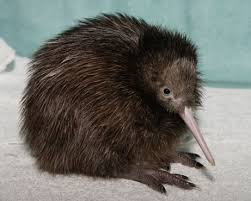
Google search for an image of the Kiwi bird and write five important facts about the Kiwi Bird.
http://www.whakatanekiwi.org.nz/about-new-zealand-kiwi/fast-facts.asp
  1. Kiwis are flightless birds.
  2. Kiwis have a strong musky smell that is irresistible to dogs.
  3. Little spotted kiwi and North Island brown kiwi breed in pairs and only the male incubates the egg.
  4. The kiwi egg is six times as big as normal as a bird its size, almost exactly the size of eggs produced by the now-extinct bush moa.
  5. A female kiwi can lay up to 100 eggs in her lifetime.
  6. Kiwi have one of the largest egg-to-body weight ratios of any bird. A mature kiwi egg averages 20 percent of the female’s body weight (compared to 2 percent for an ostrich). In human terms this would mean a 50 kilogram woman delivering a 10 kilogram baby!

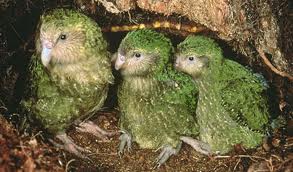
The Kakapo.
http://www.arkive.org/kakapo/strigops-habroptila/
  1. The Kakapo is the world’s only flightless parrot and is also unusual in being nocturnal.
  2. The Kakapo is the world’s most heaviest parrot.
  3. The male Kakapo produces a strange “boom” call to attract potential mates, which can be heard up to 5 kilometres away.
  4. One of the world’s longest living birds. They can live up to an average of 90 years to a maximum of 120.
  5. A polygynous lek breeder.
  6. A non-flying bird.
  7. A parachutist from trees because it cannot fly.
  8. Critically endangered.

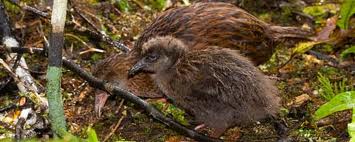
The Weka.
http://www.doc.govt.nz/conservation/native-animals/birds/birds-a-z/weka/facts/
  1. Weka mainly eat invertebrates and fruit. They occasionally eat chitons and other rocky invertebrates, lizards, rodents, food scraps, carrion and the eggs and young of other groundnesting bird.
  2. Weka populations are subject to large fluctuations. Populations increase during favourable conditions and decline abruptly when food becomes scarce. Moist islands and those with rich soils support the most stable populations.
  3. The decline and destabilisation of weka populations on mainland New Zealand, which has resulted in legal protection, has inhibited mahinga kai in modern times. Some iwi today welcome conservation projects that would potentially enable the restoration of harvesting while others believe that the time for harvest has gone. The only place where the legal harvest of weka can occur is on the Chatham Islands and on some islands around Stewart Island.
  4. Weka have demonstrated that under good conditions and with high food availability, they can be very productive with year-round breeding recorded at several sites. However, pairs in other stable populations breed once a year or less.
  5. Weka mate for life where the populations are territorial, but this is not so when the need for defence is less likely.


Tuesday, 11 March 2014

America's Cup

Bio Poem.


Bio Poem.

Alisi

Nice, helpful,  playful

Lover of eating lollies, going rock climbing and riding her bike.

Who feels happy when she is going to the movies.

Who wonders why there are volcanoes in the world.

Who fears spiders, clowns and death.

Who dreams to be a famous singer or a teacher.

Who is able to use her netbook well.

By Alisi


Monday, 9 December 2013

Healthy Food Activity.


Write fruit which start with each letter:
Apple
Banana
Calabash
Dates
Eggplant
Feijoa
Grapes
Hackberry
Ita palm
Jackfruit
Kiwi fruit
Lemon
Mango
Nectarine
Orange
Pineapple
Quince
Raspberry
Strawberry
Tangelo
Ugli
Vanilla
Watermelon
Xigua
Yellow Watermelon
Zucchini

Write down 10 vegetables
1 Carrots
2 Broccoli
3 Asparagus
4 Bean sprouts
5 Beetroot
6 Cabbage
7 Lettuce
8 Parsley
9 Rosemary
10 Onions

Write down 5 examples of carbohydrates
1 Sugar
2 Candy
3 Pasta
4 Soft Drinks
5 Cakes

Write down 5 examples of protein
1 Meat
2 Fish
3 Nuts
4 Dairy Products
5 Beans

Write down 10 unhealthy food
1 Chocolate
2 Soft Drinks
3 Chips
4 Biscuits
5 Meat
6 Candy
7 Donuts
8 Pork
9 Takeaways
10 Pies

Write down 5 healthy drinks
1 Water
2 Juices
3 Up and Go
4 Milk
5 Milo

What did you have for dinner last night? Scrambled eggs with bread and onions.

Is it healthy or unhealthy? Unhealthy.

Why is it healthy or unhealthy? It is unhealthy because egg are not good for us.


Plan a weekly menu for dinner and make sure it is healthy.


Christmas.


What is Christmas?

Christmas is a celebration of Jesus Christ’s birthday, held on the 25th December in the Western Church.
Christmas is a civil holiday in many of the worlds nations.
In the birth year of Jesus is estimated to most historians, to have been between 7 and 2 BC, the real month and day of his birth are unknown.
People think Christmas is on January the 6th, but most people believe it is on December the 25th.


History of Christmas.

Many of our Christmas traditions were celebrated before Jesus Christ was born.
Many of these traditions began with the
Mesopotamian celebration of New Years.
People only gave attention to Jesus when he was baptist, but when it was his birthday no one gave attention to him.

Where does the word Christmas come from?

The word ‘Christmas’ comes from Cristes maesse, an English phrase that means Mass of Christ.

Who is Jesus?

Jesus is a son of a peasant women.
He grew up in a village where he worked up in a carpenters shop until he was thirty.
After three days he became a wandering preacher.
He never wrote a book, held an office, he never owned a family or a house, he never went to college, he never visited a big city and he never travelled 200 miles away from the place where he was born.
He never had anything bad about him.
His father told him that he is a saviour because he crucified on the cross.
Jesus sacrificed himself for us.
When he was thirty-three years old, the tide of public opinion turned against him, and his friends ran away.
When he died he was laid in a borrowed grave of his pity friend.
He died on the age thirty-three.


Santa Claus

Santa Claus is known as Saint Nicholas, Father Christmas or Kris Kringle.
Santa is a fantasy figure with legendary, mythical, historical and folkloric origins who, in many western cultures, is said to bring gifts to homes for good children on the night before Christmas.


Netbook Reflection.


How has having a netbook help my learning?
  • Research informations from other sites.
  • Google Drive saves our work automatically.
  • We can see our class site from home.
  • We can get our work from our class site.

Has having a netbook help you communicate with your teacher?
Yes. We can send emails or we can share our work to our teacher.

What have you learnt online?
I learnt stuff about Transport, Simple Mechanism, Histories, Christmas, Heat and Other things & people.

What have you learnt from your friends?
My friend taught me how to connect to the internet.

Have you helped other people this year?
Yes. I’ve taught my friend how to upload images and how to use her netbook when she first had it.

How has digital learning help your learning?
Digital learning has helped me to communicate with other people by posting things onto my blog.


Nelson Mandela:Prisoner to President.

Nelson Mandela was in prison for 27 years in Robben Island. Then he became the first black president in South Africa. Nelson Mandela was released from prison in 1990, and he made a peaceful end to the racist apartheid regime with the leaders of South Africa’s white minority government. After 3 years Nelson Mandela shared a Nobel Peace Prize with F.W de Klerk, the last president of South Africa elected in a whites only election. Nelson Mandela was put in Pretoria Hospital on June 8th for a treatment of a recurring lung infection, the fourth time he was hospitalized since December.